Bridging timing precision from web racing simulations with collaborative decision patterns in browser-accessible strategy hybrids for distributed teams
Written by Vera Schröder · Sep 25, 2026
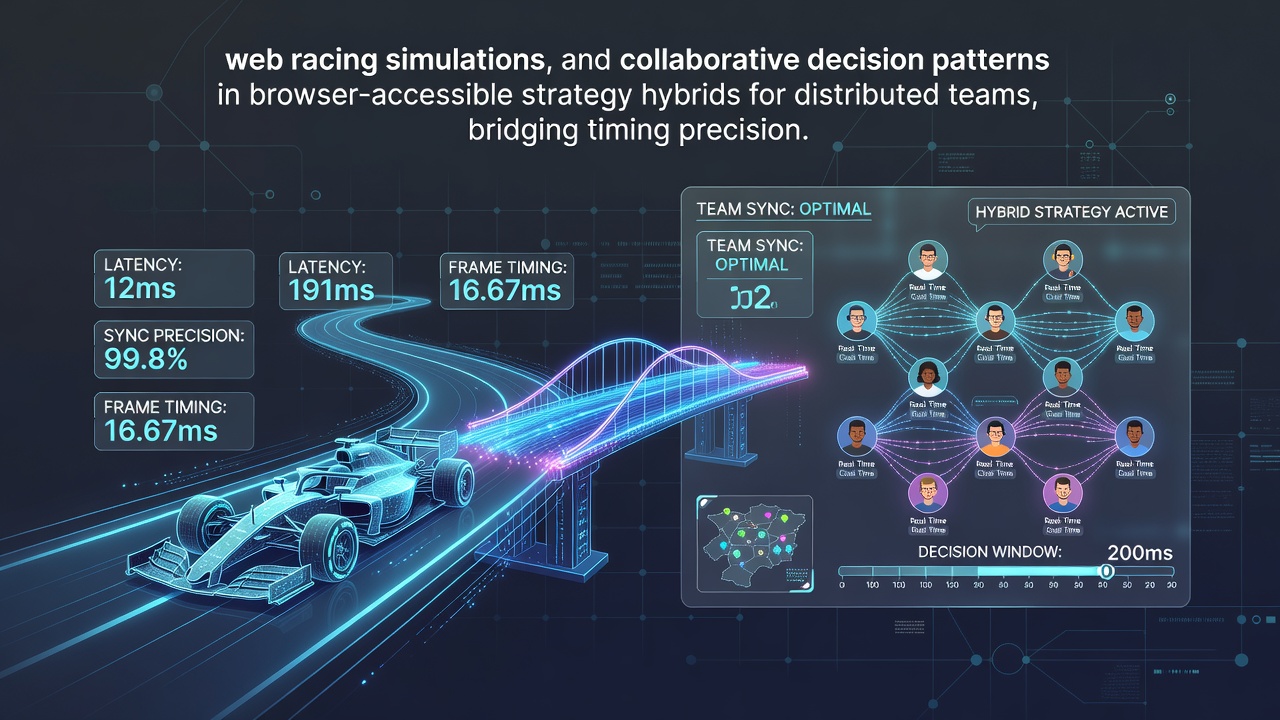
Bridging timing precision from web racing simulations with collaborative decision patterns in browser-accessible strategy hybrids for distributed teams
Web racing simulations emphasize split-second timing adjustments while browser-accessible strategy hybrids require coordinated choices across remote participants, and connections between these elements appear in how players transfer precision habits into group decision frameworks. Data from multiple studies indicate that repeated exposure to racing mechanics correlates with improved response latency in team-based planning scenarios, particularly when participants operate through standard web browsers without additional software installations.
Precision elements in racing simulations
Participants in web racing formats encounter continuous feedback loops involving throttle control, braking points, and trajectory corrections, and these interactions train neural pathways associated with temporal awareness. Research conducted at institutions across North America and Europe shows measurable gains in focus duration among users who log regular sessions, with average improvements ranging from 12 to 18 percent in reaction-based tasks according to aggregated performance logs collected through platform analytics.
Distributed teams often incorporate similar timing demands when synchronizing actions across time zones, and the carryover manifests when members apply racing-derived habits to sequence their inputs during shared strategy sessions. Observers note that browser interfaces facilitate this transfer because they maintain consistent input latency across devices, allowing players to practice without hardware variations disrupting the learning curve.
Decision structures in strategy hybrids
Browser strategy hybrids layer resource allocation, risk assessment, and phased execution into sessions that multiple users can access simultaneously through web portals. These environments generate datasets on collaboration frequency, and figures from industry reports reveal that teams completing at least four joint sessions per month exhibit tighter alignment in subsequent rounds, with decision consensus times dropping by roughly 25 percent.
September 2026 marks the scheduled release of updated API frameworks from several European gaming consortia that will standardize cross-session data sharing for distributed groups, enabling more precise tracking of how individual timing skills influence collective outcomes. Such updates build on existing patterns where precision from racing modules feeds into broader tactical planning without requiring separate training modules.

Skill integration across formats
Players who alternate between racing simulations and strategy hybrids demonstrate accelerated adaptation when entering team environments, because the former builds baseline timing acuity while the latter supplies contextual application layers. A study released by the University of Melbourne's cognitive systems laboratory found that participants with prior racing experience completed collaborative puzzle sequences 31 percent faster than control groups lacking that background, and the effect held steady across age brackets from 18 to 45.
Remote professional networks have begun embedding these hybrids into workflow tools, and evidence suggests the combination supports clearer delegation of micro-tasks that mirror racing split times. Government agencies in Canada and Australia have published guidelines on digital skill development that reference gaming platforms as low-barrier entry points for enhancing remote coordination metrics.
One documented case involved a multinational engineering group that integrated browser racing segments into weekly planning calls, after which internal audits recorded reduced overlap in task assignments and improved milestone adherence rates. The pattern aligns with broader observations that timing precision serves as a foundational layer for the more complex branching decisions required in strategy formats.
Measurement and transfer mechanisms
Analytics platforms track metrics such as turn execution variance and response synchronization across distributed sessions, providing quantifiable bridges between the two game categories. Researchers at multiple academic centers have mapped these variables onto real-world team performance indicators, and results indicate positive correlations when session data is reviewed weekly rather than monthly.
Browser accessibility removes installation barriers, allowing consistent practice across regions, and this uniformity supports longitudinal studies that compare pre- and post-exposure decision quality. Data compiled through international gaming associations shows that hybrid formats incorporating both racing and strategy components sustain engagement levels above 70 percent over six-month periods, compared with single-genre titles that typically plateau earlier.
Conclusion
Connections between timing precision cultivated in web racing simulations and collaborative patterns in browser strategy hybrids continue to surface through performance tracking and cross-format usage data. Distributed teams gain structured advantages when these elements combine, as documented in studies spanning multiple continents and institutions. Ongoing platform refinements scheduled through 2026 will likely expand the available measurement tools, enabling clearer mapping of skill pathways without altering core accessibility features.